Positive Paradox, Kali, Luzern
Splash, Tara Down, NY
L’illusion d’une promesse, High Art, Paris
La Patchiness de Mon Coeur, Pauline Perplexe, Paris
The will is almost nothing, Donws&Ross, NY
Sublime Rage, French Place, London
(text) Gork, Raffaele Pola at Pakt, Amsterdam
(text) Warren, Rabbits, Tunnels, Arto van Hasselt at Goldsmith, London
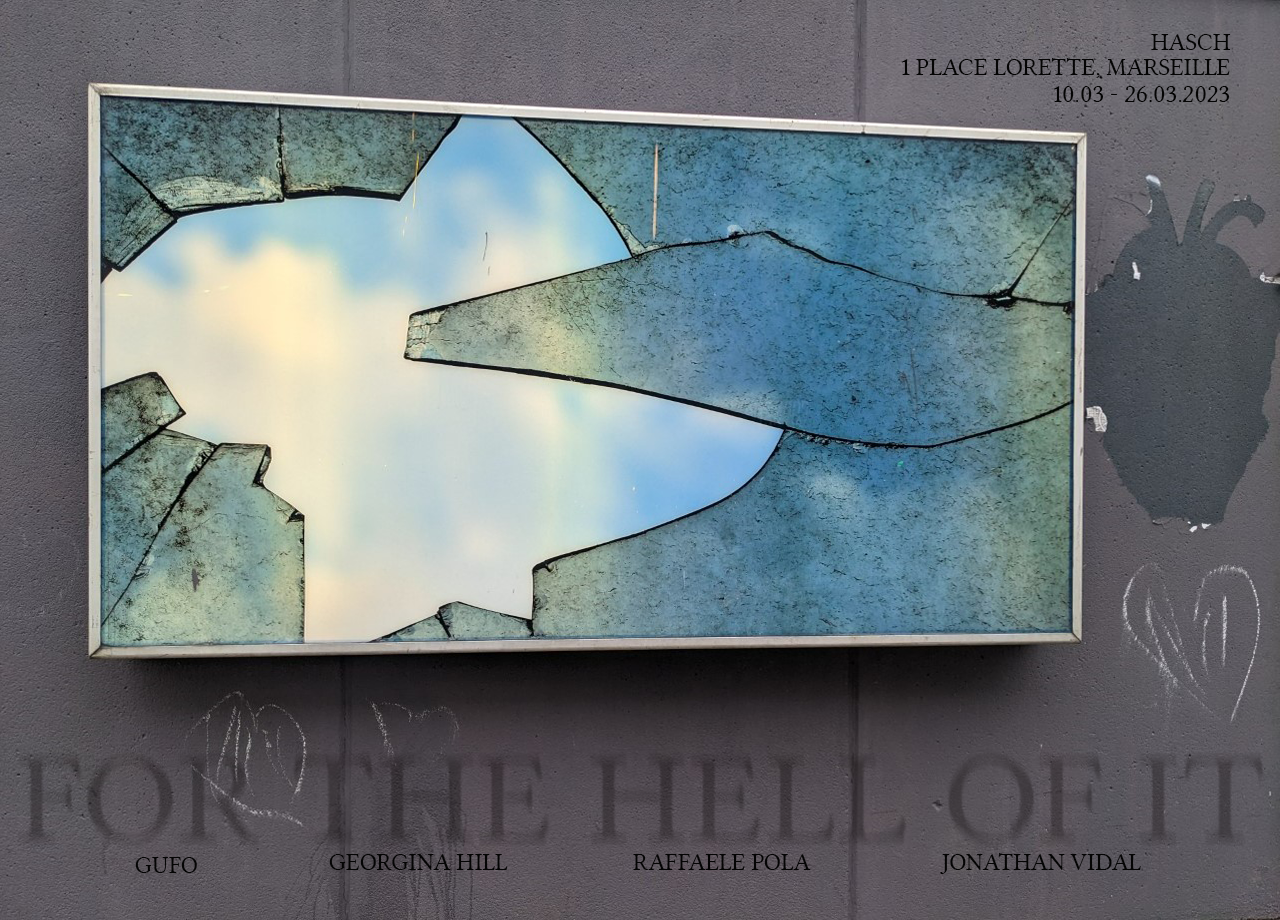
(text) For the hell of it, group show at Hasch, Marseille
(in progress) Quand il m’arrive
CV
« I went to the balcony and grabbed a little pot of
flowers, and when the man reappeared at the door, I let my engine of war drop
down perpendicularly on the back of his pack carrying glass. The shock knocked
him over, and he ended by breaking his entire poor itinerant fortune under his
back, which produced the brilliant sound of a crystal palace smashed by
lightning.1»
Like the children who decouple the gendarmes as they
crawl around in an asymmetrical dance for procreation specific to their species:
they pretend to want to “set them straight”, but mostly they take a malicious
pleasure in peeling them off, sensing the bestiality of their action. Like
roasting slugs. Like burning cars. Like getting hammered or killing the worm,
which would bring us back to the glass, the one that explodes at the end of The
Bad Glazier, from which we have just read an extract2.
This psychological tendency, described as ‘natural’ in humans, could be
translated as “a death instinct” or, kindlier, as “a taste for risk”.
For
some people, the sound of shards of glass echoes harmoniously with the
acceptance of the other side of our existence; the side that allows us to
decouple the gendarmes, the side that tells us that there are things that
cannot be explained. But for many, this same sound is a crash. It is alarm of
anomaly. The sound has thus become audio material used as a learning model for
artificial intelligence to detect signs of irregularity. But can the machine
hear the sound of the deliberate negligence necessary for the creation of
intentions? Does it know that the flirtation between stupidity and accident,
however indecent it may be for hyper-moral algorithms, gives birth to a balance
that lighten the benevolence of curiosity, that will complement reason with
inconsistency?
Miraculously, when it happens, when the beaks are
welcomed, when machines, rather than being trained with shards of glass, are lulled
by ASMR whispering “breaaak break bbbbreak”, then we can understand what
Jenifer Bajoreck3 links to
an ironic force of interruption and disarticulation of capitalist ideology. The
irony here is that destruction or excess energy transcends those who break
things. The irruption is a frivolity that is not premeditated but is justified
by something that goes beyond its author, and which, without accusing total
coincidence, thanks the good intuition. For the hell of it, despite myself,
but for the good, the good of hell4!The exhibition brings together practices that take into account their
accidental, silly, curious origins, perhaps because they trust in the irony of
coincidence to cut short with Manichaeism.
[1] Baudelaire, The Bad Glazier, 1855-64
[2] In French, “killing the worm” designate “drinking on
an empty stomach”. Worm and glass are homonyms.
[3] Jennifer Bajorek, Counterfeit Capital: Poetic
Labor and Revolutionary Irony, 2008
[4] Written in English in the original text